


MARKETING AUTOMATION
Marketing-Automation that Scales
Efficiency. Scalability. Clean Data.
- Google Ads · Automation & Scripting
- Excel & Google Sheets · Automated Workflows
- Rule-Based Campaign Management
- Data Processing & Script Workflows
- Process Optimization & Technical Consulting
Get an Automation Strategy
Built for Teams That Need to Scale
AUTOMATION & DATA
Google Ads Automation and Data Reporting
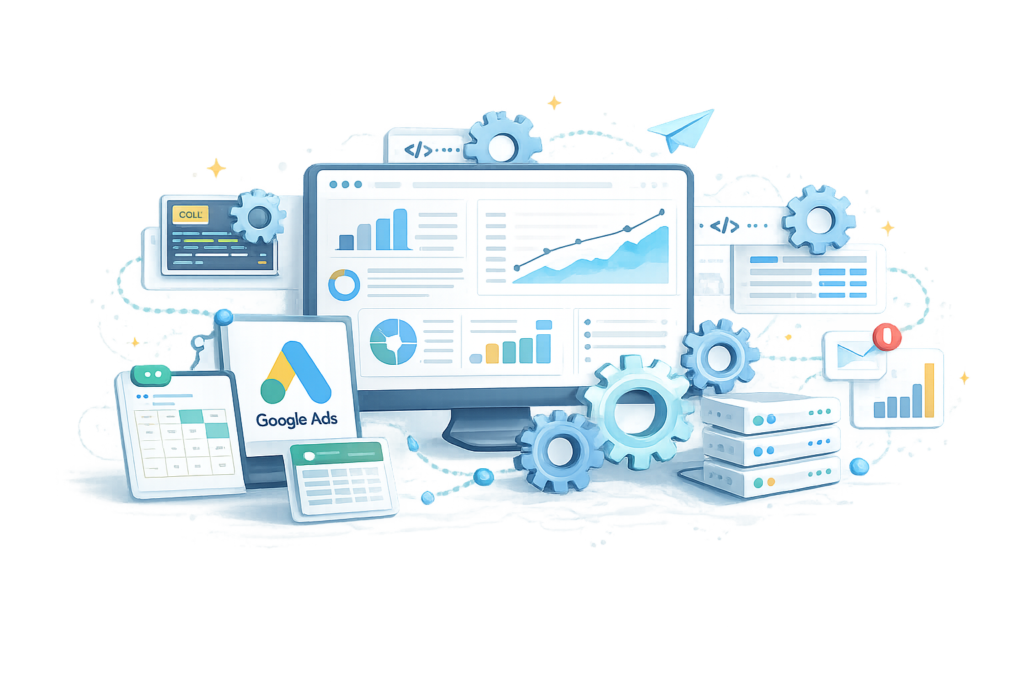
Marketing automation enables structured, data-based management of Google Ads accounts.
Google Ads scripting, automated Excel and Google Sheets workflows, and BigQuery-based reporting reduce manual effort and support consistent data handling.
Rule-based scripts cover monitoring, budget control, bidding logic, alerts, and performance checks.
Centralized reporting consolidates campaign, conversion, and cost data across multiple accounts in a scalable and transparent structure.
READY TO GROW?
Let’s get to work.
Your Benefits with Professional Marketing Automation
Scripts manage budgets, bids, and alerts based on KPIs — less manual work, more control.
Without automation, errors, delays, and inefficient budget allocation occur.
Sheets/Excel and BigQuery consolidate data reliably — clearer KPIs, faster decisions.
Fragmented data sources lead to conflicting numbers and incorrect optimizations.
API workflows connect tools and accounts — processes scale without added effort.
Without integrations, data and processes stay separate — scaling becomes costly and slow.
FAQs about Marketing Automation
Marketing automation refers to the use of scripts, rules, and data workflows to manage marketing processes automatically. It reduces manual tasks and ensures consistent handling of campaigns, data, and reporting.
Marketing automation addresses issues such as repetitive manual work, inconsistent data, delayed reporting, and human error. It helps create reliable processes and clearer performance insights.
Automation allows campaigns and data workflows to grow in volume and complexity without increasing manual effort. Rules, scripts, and centralized reporting enable stable scaling across multiple accounts and platforms.
Yes. Automation setups can be tailored to specific account structures, KPIs, tools, and workflows. Scripts and processes are adapted to existing systems rather than using one-size-fits-all solutions.
What Our Clients Say About Working With Us
“We received active support with our online marketing and achieved excellent results. The team kept us well informed and continuously highlighted opportunities for optimization. The cooperation was friendly, transparent, and highly professional — we are happy to recommend this service.”

“Outstanding work in online marketing, whether it’s SEO or SEA. A true specialist team that is always reliable and takes care of any issues promptly. Highly recommended.”

“Great work in online marketing and social media. The team was always reliable, kept us well informed, and handled any issues quickly. We felt well supported throughout the entire process.”

“From social media setup to targeted ad campaigns, ELKEON handled our online marketing with clarity and precision. The process was structured, transparent, and tailored to our business. A reliable partner we’re happy to recommend.”